

Call Us +91 8591039607
Patient Support
Timings 07:00 PM to 09:00 PM
Book Appointment
Call Us +91 8591039607
Patient Support
Timings 07:00 PM to 09:00 PM
Book Appointment
Home Services
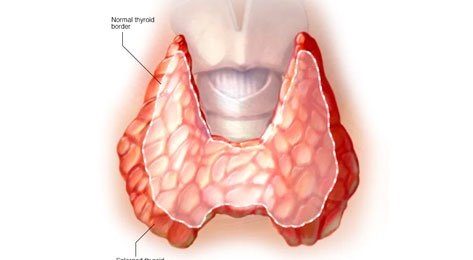
A goiter is the irregular growth of the thyroid gland. The thyroid is a butterfly-shaped gland located at the base of the neck just below the Adam's apple.
A goiter may be an overall enlargement of the thyroid, or it may be the result of irregular cell growth that forms one or more lumps (nodules) in the thyroid. A goiter may be associated with no change in thyroid function or with an increase or decrease in thyroid hormones.
The most common cause of goiters worldwide is a lack of iodine in the diet. where the use of iodized salt is common, goiters are caused by conditions that change thyroid function or factors that affect thyroid growth.
Treatment depends on the cause of the goiter, symptoms, and complications resulting from the goiter. Small goiters that aren't noticeable and don't cause problems usually don't need treatment.
Most people with goiters have no signs or symptoms other than a swelling at the base of the neck. In many cases, the goiter is small enough that it's only discovered during a routine medical exam or an imaging test for another condition.
Other signs or symptoms depend on whether thyroid function changes, how quickly the goiter grows and whether it obstructs breathing.
Two hormones produced by the thyroid are thyroxine (T-4) and triiodothyronine (T-3). When the thyroid releases T-4 and T-3 into the bloodstream, they play a role in many functions in the body, including the regulation of:

Dr. Sukirti Misra is a Diabetologist and Endocrinologist (Adult and Pediatric) practicing in Mulund. She has completed her MBBS from G.M.C, Nagpur. She has received a Gold medal in MBBS. She has done her MD in General Medicine from Mumbai. She has completed her DM in Endocrinology from T.N.M.C, Nair hospital, Mumbai.
Copyright © 2022 Dr. Sukirti Misra.